Purpose
Support dependable nutritious seafood, healthy ecosystems and stronger coastal and local livelihoods.

Sustainability · Sustainable Blue Economy
V5 / Institutional aquaculture platformResponsible aquaculture can help deliver nutritious protein with a smaller environmental footprint, while supporting coastal communities and protecting the ecosystems on which production depends.
Evidence before scale · Joint governance · Productive assets
Why the blue economy matters
A sustainable blue economy connects dependable nutritious food and economic opportunity with the health of the waters and ecosystems that make production possible.
V5’s value-add aquaculture infrastructure strategy connects investment with practical improvements in biology, resource use and local capability. Nordic technology and biotechnology expertise, adapted with operating teams, can improve juvenile quality, survival, nutrition and production reliability.
Skilled employment, training and local suppliers are part of the intended contribution. Production must remain compatible with receiving-water quality, habitat protection and site carrying capacity. Environmental performance depends on species, feed, energy and the production system.
Support dependable nutritious seafood, healthy ecosystems and stronger coastal and local livelihoods.
Combine strategic equity and structured financing with infrastructure upgrades, Nordic expertise transfer and accountable governance.
Establish an asset baseline, define material targets and report progress, incidents and limitations.
Use no sustainability label, certification or regulatory classification unless it is formally supported.
Simple language should make sustainability claims easier to understand and compare; robust asset evidence should make them credible.
European Commission · SFDR review proposal ↗Institutional alignment
V5 is highly and directly aligned with the Sustainable Blue Economy at the level of sector, strategy, ownership model and intended value creation.
Seafood is not an incidental ESG allocation. Sustainable aquaculture and its productive supply chain sit at the core of V5's Greece programme, supported by separate development pathways in Denmark and Oman.
Alignment is earned and maintained through selection, ownership, improvement, measurement and transparent reporting. It is not a substitute for asset-level evidence.
Sustainable aquaculture and its productive seafood supply chain are central to V5's mandate, not an incidental ESG allocation.
Established productive assets and operating businesses; strategic equity, structured financing, targeted upgrades and improved cash generation.
Direct stakes and governance rights enable the transfer of Danish technology, science, training and operating disciplines.
Licences, biology, water, feed, welfare, labour, climate, waste, traceability and community risk are embedded in the investment lens.
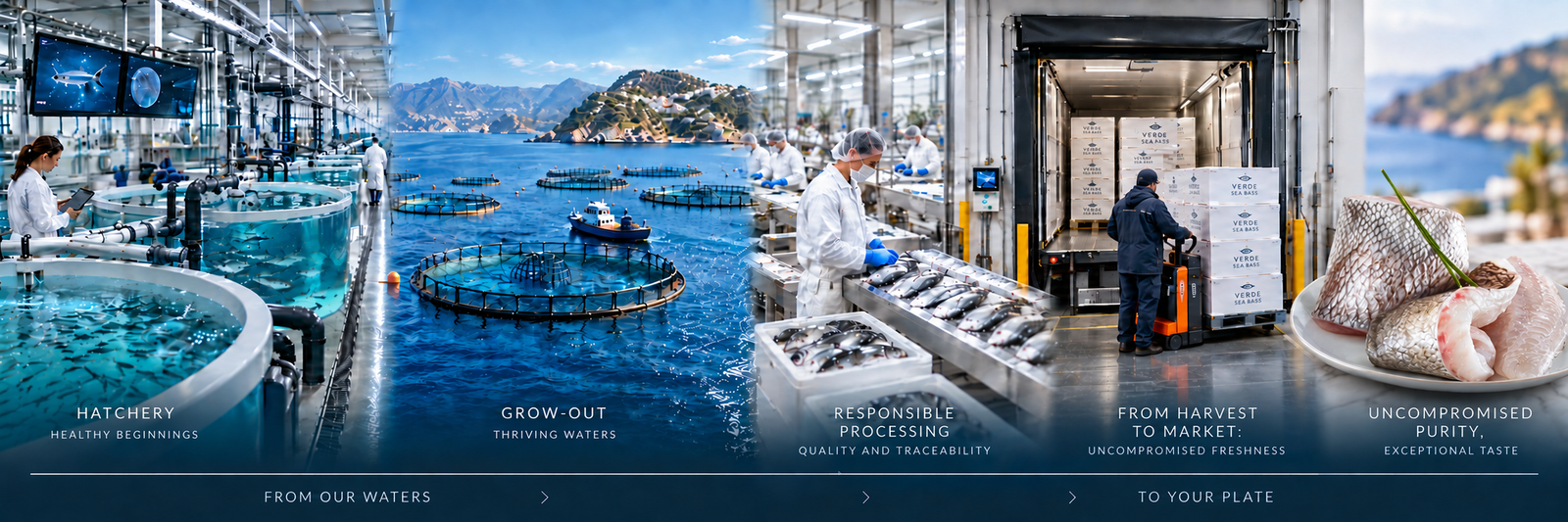
UNCOMPROMISED FRESHNESS
FROM HARVEST
TO MARKET
UNCOMPROMISED PURITY
EXCEPTIONAL TASTE
Asset-level scorecard
Food-transition objectives must connect with operating results, healthy receiving waters and benefits to coastal and local communities.
Measure progress against a clear baseline, using consistent definitions and independent verification where practical. Report both absolute impacts and impacts per kilogram; distinguish projected benefits, observed company results and V5-attributable improvements.
Survival and mortality · biosecurity · medicine use · escapes · species-appropriate welfare indicators
Feed conversion · feed sourcing · energy and emissions per kg · water use · effluent and discharge quality
Processing yield · by-product recovery · waste · cold-chain performance · traceability
Local jobs and supplier spending · training and competence · worker safety · labour standards · community engagement · accountable board oversight
Saleable juveniles and harvested tonnes · edible yield · product quality · food losses · nutritional composition where measured
Cost per saleable juvenile and kilogram · realised selling price · processing yield · cash after operating and maintenance needs
Turning the Tide
V5 is institutionalising UNEP FI's seafood guidance as a sector annex to its investment and environmental-and-social risk policy.
The framework complements, but does not replace, law, permits, veterinary rules, asset-specific biological limits and investment-committee judgement.
Do not finance unlawful activity or activity that represents a severe exclusion. Suspend funding if such activity is identified after closing.
Unlicensed or prohibited sites; mandatory carrying-capacity non-compliance; banned chemicals; unlawful invasive species; labour or human-rights abuse; deliberate welfare abuse.
Finance only with a dated, costed and governed improvement plan, covenants, monitoring and escalation if the agreed remedy fails.
Ecological sensitivity; disclosure gaps; water and pollution; escapes; disease and biosecurity; feed; wildlife interactions; carbon; welfare; community impacts; waste; physical climate exposure.
Prioritise investments that improve financial performance while producing measurable environmental or social outcomes.
Biosecurity; precision feeding and FCR; lower-impact feed; escape prevention; energy efficiency; traceability; processing yield; by-product recovery; local jobs; climate resilience.
Applied across aquaculture, fisheries and cross-cutting supply-chain issues, including biodiversity, water, feed, welfare, labour, climate, waste, traceability and community impacts.
2027–2030 policy direction
These milestones are proposed in V5's 2026–2031 Institutional Business Plan and remain subject to formal adoption, asset baselines and applicable approvals.
Screen every new investment against the Avoid class; freeze and escalate any legacy discovery immediately.
Map owned or financed production sites and establish material seafood-criteria baselines with accountable action plans.
Set asset-appropriate targets for feed, water, welfare, circularity and responsible-standard readiness.
Proposed pathway from 75% of controlled seafood sales by end-2027 to 100% by end-2028.
Report target progress, incidents, exclusions and material changes, with third-party verification where practical.
The investment gap
The European Commission's BlueInvest Investor Report 2026 maps growing blue-economy interest while finding that later-stage funding remains relatively limited.
That is where V5 is designed to operate: established operators, positive and sustainable operating earnings, direct ownership, co-management, modernisation, scale and credible refinancing or exit pathways.
European Commission · The next wave of blue growth ↗≈ €3bn fully dedicated capital
≈ €11bn partially exposed capital
Evidence-led communication
High Sustainable Blue Economy alignment supports V5's positioning. It is not, by itself, a legal product label, certification or third-party endorsement.
Operators · Family businesses · Investors